Repair, refurbishment, fabrication and adaptation of bodywork. Truck and van box bodies, impact and bridge-strike damage, cab and paintwork, roof skins, refrigerated bodies, tarpaulins, rear underrun protection bars, roller shutters, welding in all materials. In-house workshop, truck paint booth, chassis on the straightening bench: your vehicle stays with us from dismantling to painting.
A body never deteriorates all at once: a corner dented at the dock, a pillar that flexes, a floor that takes in water, and eventually the structure can no longer hold the doors in alignment. The visible result comes late — a door that closes badly, a leak — while the cause is long-standing.
We rework the structure, not just the visible sheet metal: pillars, crossmembers, floor rails, corners and sills. You get back a body that is true, doors that close on their seals, aligned panels, and an intact load volume.
We work with the four materials found in the French fleet — steel, fibreglass, plywood and aluminium — and we adapt the method to the body: a fibreglass panel is not repaired like a riveted aluminium skin.
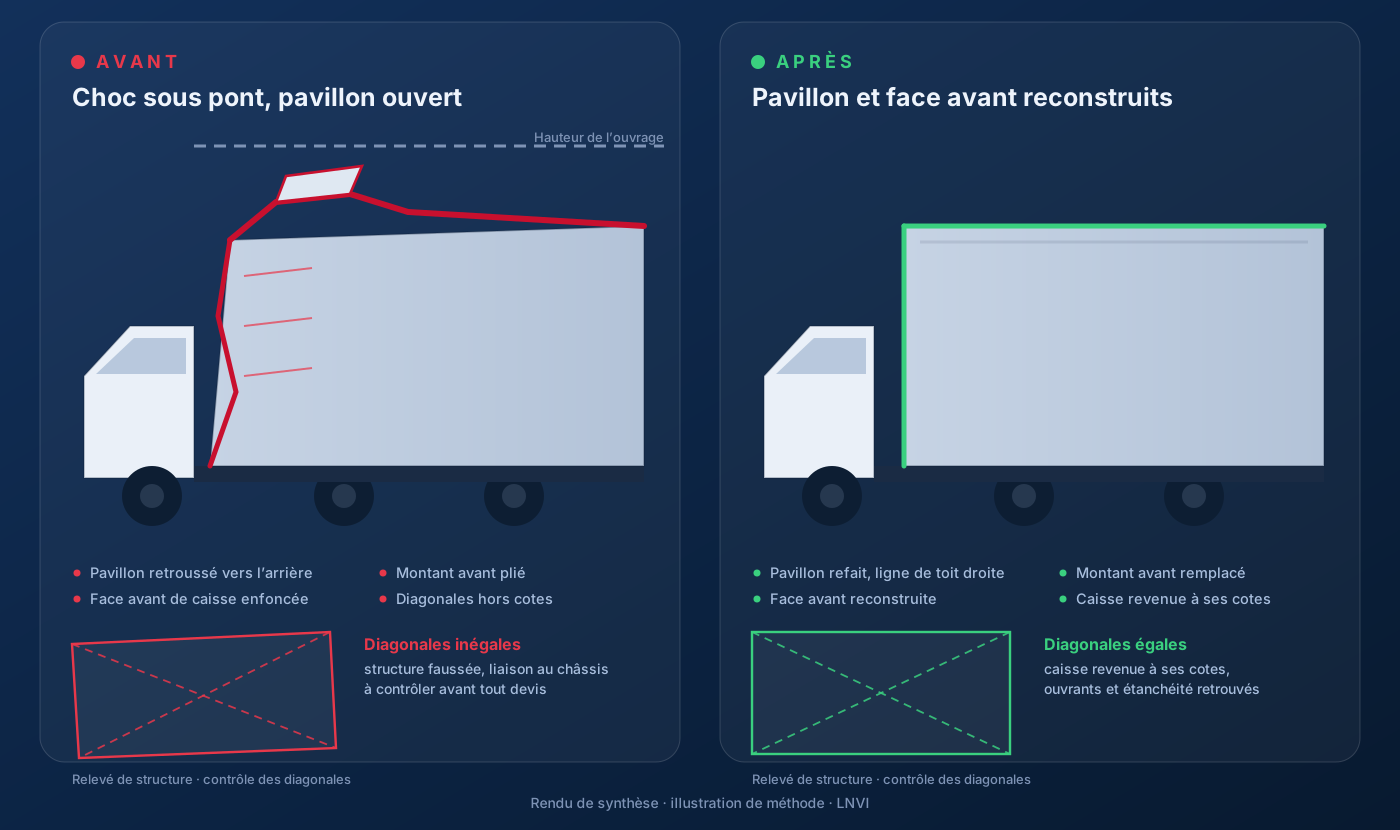
It is the most spectacular accident in transport, and the one that provokes the most hasty decisions. A bridge strike does not condemn the body. In most cases, the structure is rebuilt at a cost far below replacing the bodywork, and the vehicle leaves with its original dimensions.
The first step is not the bodywork, it is the diagnosis of the structure: we record what actually took the impact — roof, front face of the body, pillars, connection to the chassis — before announcing anything. It is this survey that makes the difference between a sound repair and a body that will flex for life.
We also handle the insurance file from start to finish: photographic survey, detailed estimate, presentation to the expert, technical exchanges and follow-up until agreement is reached. You follow the progress; you don't manage the procedure.
Do not drive the vehicle before the survey. After a bridge strike, a body that seems to hold may have lost its connection to the chassis. Send us four photos — rear face, both sides, roof — and we will tell you what can be repaired before any movement.
A new large-volume body, fitted and painted, is an investment that few operators can write off after a simple impact. Yet a composite panel can be repaired: we strip back to sound material, treat the crack along its full length — it almost always runs further than the visible impact — laminate, sand, reshape, then repaint with blending onto the adjacent panels.
Replacement remains the right decision when the structure itself has given way: torn-off pillars, detached floor, distorted connection to the chassis. It is a structural survey that decides, not a photo. We tell you which of the two applies before quoting, with the evidence that supports it.
On a 20 m³, the body provides the rigidity of the vehicle: it works in torsion at every bend and every loading dock. A surface-only repair, without reworking the structure, reopens within a few months — and the second repair costs more than the first one done properly.
Second pitfall: watertightness. A poorly treated crack lets water in between the skins, the foam soaks up water, the body gets heavier and the panel peels away over metres. It is invisible for a year, then it is beyond recovery. We treat watertightness as a job in its own right, not as a finishing touch.
The 20 m³ body is the most widespread format in urban distribution, and the worst served. Many workshops refuse: it takes ceiling height, a straightening bench, panels, and the know-how to work sandwich panels as well as polyester. We do it all year round, on rigid trucks as well as heavy vans.
What comes back most often on a 20 m³ body: the side panel dented at the loading dock, the torn-off rear corner, the cracked floor crossmember, the roof skin split by a branch or an awning, the deformed sill and door pillars, the seal failing around the lights and the drop sides.
We repair rather than replace when the structure allows it: on a large-volume body, a panel repair costs two to five times less than a new body, and the vehicle is back on the road in a few days instead of several weeks. When the structure does not allow it, we say so before starting, with photos to support it.
The 20 m³ bodies we receive come from all over the Île-de-France: Seine-Saint-Denis, Val-d’Oise, northern Paris, Roissy, Seine-et-Marne. Rental companies, couriers, food distributors, local authorities.
On a temperature-controlled body, an impact is not just a bodywork problem: it is a thermal bridge, so the refrigeration unit consumes more, the temperature drops out of range and, at the end of the chain, a load is rejected.
We repair insulated panels, doors and their seals, hinges, locking bars, sills and air curtains, restoring the insulation and not just the appearance. The final check is carried out with the door closed.
Your rigid truck comes out painted in a truck paint booth, colour matched, without going through a subcontractor: no transfer, no extra day of downtime, no file circulating between two workshops. This is the point where most truck bodyshops stop, and where downtime doubles.
On impacts that have affected the structure, straightening on the bench restores the manufacturer's dimensions of the chassis or the cab. It is this dimensional check that distinguishes a repair accepted by an expert from an approximate reshaping.
We also handle what shapes the image of your fleet: painting in company colours, blending onto adjacent panels, complete refurbishment of a vehicle before it joins the fleet or before resale.
The roof skin concerns all panel vans, not only refrigerated ones. It is the part nobody looks at and it protects the entire load. Cause number one of damage: passing under a bridge, an archway or a car park entrance that is too low — the roof tears along its full length within a few metres.
Water ingress costs more than the repair: wet goods, customer disputes, swollen plywood, insulation soaked with water. We remove the skin, treat what is underneath, and hand back a roof that is watertight and checked, not a patch-up that reopens with the first winter.
A refrigerated body is not just an insulated van: it is made of sandwich panels — two skins and an insulating core bonded into a single block. A dent crushes the insulation, creates a thermal bridge, and the unit compensates by running constantly. The defect shows first in fuel consumption and in the temperature log, not on the sheet metal.
The stakes are not cosmetic: they are the breakdown of the cold chain, goods rejected on delivery and the health inspection. You get back a body whose insulation and watertightness are restored — panel replaced to standard, new seals, doors that close properly all the way round.
A torn tarpaulin does not wait: water gets in, the tear lengthens with every trip, and the repair changes category within a week. Caught early, it is treated by heat welding — a weld of material, not a glued patch that peels off at the first wash.
On tautliners and curtain-sider trailers, wear shifts to the fittings: stretched straps, broken buckles, torn-out eyelets, a rail that catches. You get back a curtain that slides without effort and tensions properly, which protects the tarpaulin itself for much longer.
A deformed underrun bar is a re-test item at the roadworthiness test, and a safety component in question in the event of an accident. It is also the part that is put off the longest, because it does not affect driving — until test day.
We straighten the bar when possible and replace it when it has lost its absorption capacity. In both cases, you leave with an assembly that is compliant, at the right height and setback dimensions, brackets included — because the defect often comes from the mountings, not the tube.
A jammed curtain means a delivery round that doesn't leave. The roller door — FIT is the market reference, fitted at the rear of vans and semi-trailers — removes the opening manoeuvres at the dock: no leaf to clear, no extra reversing, a few seconds saved at every delivery point. When it jams, the whole vehicle becomes unusable.
You get back a door that lifts with one hand and comes down with correct tension, slats aligned, guide rails straight, no tight spots. We work on the existing curtain when the structure allows it, and replace the complete apron when the repair would not last — you know which of the two before you approve.
We also fit roller doors on new vehicles and as a retrofit: replacing a hinged door with a roller door on a van in service is decided on a simple dimensional survey.
These are the parts that take all the knocks: mudguards torn off by the kerb, the step bent when climbing down from the cab, the tool box knocked loose, the spare wheel carrier that vibrates. Individually, nothing serious. Combined, they give a vehicle — and therefore a company — a neglected image in front of the end customer.
We deal with them during the same visit as everything else, with no dedicated downtime: your vehicle is already in the workshop for a repair or servicing, and these jobs are added to the repair order and leave with it.
It is the know-how that decides what is repairable and what is not. Many workshops send a chassis crack, a crane arm or an aluminium platform to complete replacement, for lack of knowing how to weld anything other than steel. We weld steel, aluminium and stainless steel, and that is what makes it possible to repair instead of replace — often a decisive difference on the invoice.
The gesture is not enough: a weld laid over a crack that starts again is a repair to be redone. We treat the mechanical cause — reworking the area, crack arrest, sized reinforcement — so that the part returns to service, not so that it lasts until the next load.
The same workshop also does adaptation and fabrication: custom brackets, floor reinforcement, equipment mounting plates, parts that no longer exist in the catalogue.
A well-adapted vehicle saves time at every stop, every day of the year. It is the area where a fleet recovers its investment fastest: a few seconds saved per delivery, multiplied by the number of stops on a round, change the number of customers served in a day.
The side door is the most profitable conversion in urban distribution: the side of the van is opened up — sliding or hinged — and the load becomes accessible from the kerb side, without opening the rear, without reversing, without stepping into traffic. We fit it on a van in service, with structural reinforcement and watertightness rework.
The conversion of the rear doors into an awning with tail-lift closure meets another need: moving from hand loading to pallet loading. The leaves give way to an upward-opening cover, and the tail lift becomes both a loading platform and the closure. You gain level access on a vehicle you already own, without changing trucks.
A bodywork claim immobilises you twice: once at the workshop, once in the procedure. We take the second part off your hands.
Damage survey, photographic report and detailed item-by-item estimate, enforceable against the expert.
We receive the expert at the workshop, present the survey and technically defend each repair item.
Work starts on written agreement. Anything discovered during dismantling is the subject of an additional estimate submitted for approval.
End-of-work photos, complete file sent, and online progress tracking throughout the downtime.
The estimate covers the damage recorded at the initial survey. Anything that appears during dismantling — corrosion under a panel, deeply affected structure, damaged component — is the subject of an additional estimate presented before work begins and subject to your agreement. You decide, at every step, on a known amount.
No, in the vast majority of cases. The roof and the front face of the body can be rebuilt, and the body regains its dimensions. The decision is made on a structural survey, never on a photo alone: it is the condition of the connection to the chassis and of the pillars that decides, not the look of the roof.
Both. As long as the guide rails and structure are sound, the curtain can be repaired — individual slats, straps, springs, shafts. When the apron has worked too much, complete replacement is the only lasting solution. We tell you which of the two applies before quoting, not after.
Yes. The workshop is multi-brand on rigid trucks, tractor units, vans, trailers and semi-trailers, whatever the make of the chassis and of the body.
Yes, from start to finish: photographic survey, detailed estimate, receiving the expert at the workshop, technical defence of the items and follow-up until agreement. You stay informed; you don't manage the procedure.
It is even recommended. The workshop is integrated: servicing, mechanics, hydraulics, tyres and bodywork are handled in the same visit, on a single repair order. One downtime instead of two.
Send photos with the form below: an overall view, both sides and a close-up of the affected area, plus the registration number. This is what allows us to quote without a prior visit in most cases.
Yes, including sandwich panels: panel replacement, repair of crushed insulation, treatment of thermal bridges, insulated doors and seals. It is a distinct trade from the standard van, and it is treated as such.
Yes, it is one of our most common formats: side panel, rear corner, floor crossmember, roof skin, sill and door pillars, watertightness. On rigid trucks as well as heavy vans, all bodywork makes.
116 avenue Aristide Briand, 93150 Le Blanc-Mesnil, at the gates of Paris via the A1 and A3, right next to the Roissy CDG logistics zone. We work for businesses throughout the Île-de-France (Paris region).
Describe the damage, attach your photos: your request goes directly to the person who prices it.


We have been working with this garage for years, and there has never been the slightest problem. Very professional team, top notch!
Hugues K.A team at your service. Quality work in record time. Deadlines are always perfectly met.
Pascal M.Exactly the kind of partner we needed. The service is very fast and lives up to our requirements.
Valérie G.